Takt Time Calculator
Enter shift length, breaks, shifts and customer demand to get the takt time, and add the work content to see how many stations you need.
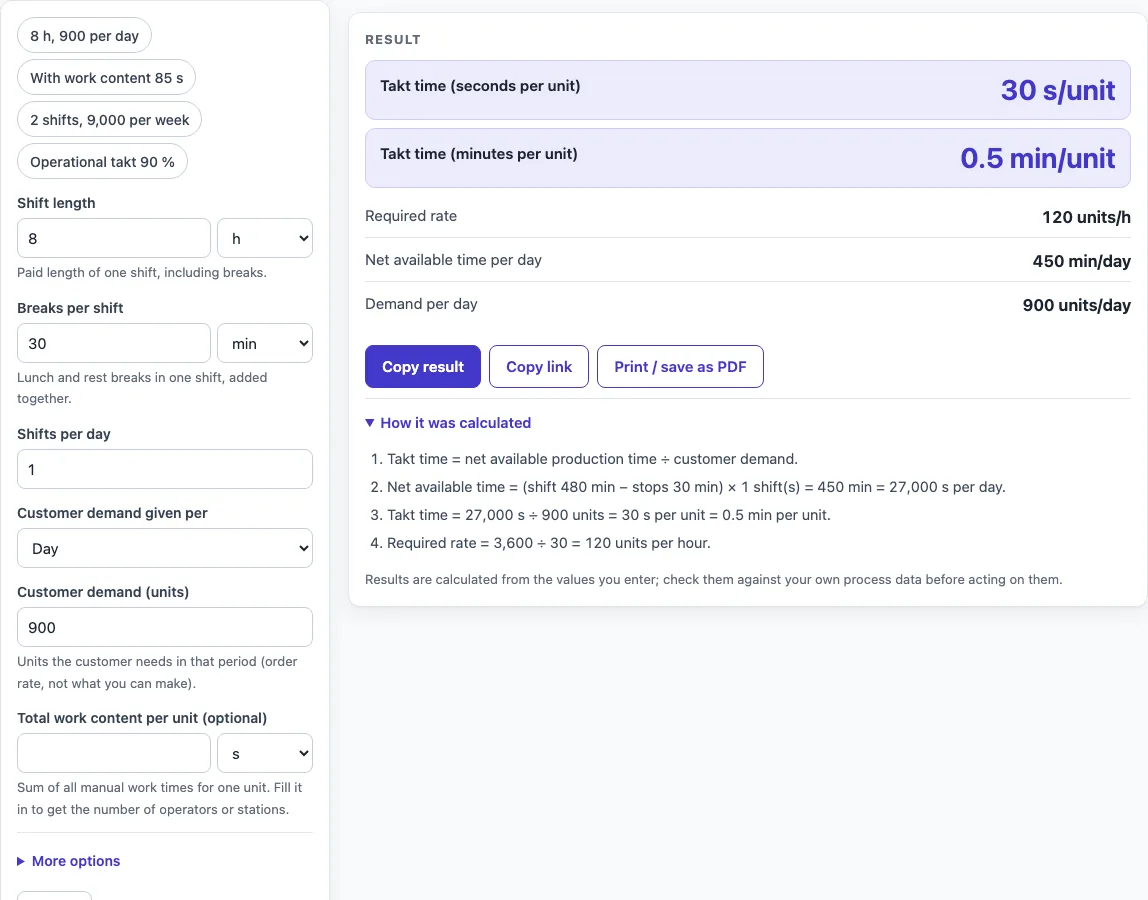
How to use the Takt Time Calculator
- Load a preset button above the form, such as ‘8 h, 900 per day’, or keep the starting example.
- Enter the shift length in hours or minutes.
- Enter the breaks per shift and other planned stops per shift, in minutes or hours.
- Enter the number of shifts per day. It must be a whole number.
- Enter the demand and choose its basis: per day, per week (the calculator divides by your working days per week), or per shift (the calculator multiplies by shifts per day).
- Optionally enter the total work content per unit, in seconds or minutes, to get the number of operators or stations and the line balance efficiency.
- If needed, open More options and set the operational factor in percent.
- Read the results: takt time in seconds and minutes per unit, units per hour, net available time per day in minutes, and demand per day.
- Open How it was calculated to check the formula, the substituted values and the units.
If a field shows an error, check that shift length and demand are positive numbers, that breaks and stops leave some of the shift free, and that working days per week do not exceed 7. Reset restores the starting example at any time.
How do you compute takt time?
Takt time is the net available production time divided by customer demand, giving the seconds available to make one unit. To compute it, find how long the line can actually run in a day, then divide that time by the number of units the customer needs in the same day.
- Net available time per day = (shift length − breaks per shift − other planned stops per shift) × shifts per day.
- Convert the result to seconds by multiplying minutes by 60.
- Takt time = net available time ÷ demand per day.
For an 8 h shift with 30 min of breaks, one shift, and demand of 900 units per day: (480 − 30) = 450 min, which is 27,000 s. Takt = 27,000 ÷ 900 = 30 s per unit, or 120 units per hour.
Takt time formula: what does each part mean?
Takt time = net available production time ÷ customer demand. The net time is the part of the shift when the line is planned to produce, so breaks and planned stops are removed before dividing.
Work content is the total time needed per unit, summed across all tasks. When it is given, the number of operators or stations = work content ÷ takt, rounded up. Line balance efficiency = work content ÷ (stations × takt time), shown in percent. Using the example above with 85 s of work content: 85 ÷ 30 = 2.83, rounded up to 3 stations, and efficiency = 85 ÷ (3 × 30) = 94.4 %.
If work content is longer than takt, one station cannot finish it in one takt, so more than one is needed. Efficiency below 75 % with more than one station means considerable idle time across the stations.
How does the takt formula work with weekly or per-shift demand?
Use the same formula, but first turn the demand into a daily figure. For weekly demand, divide by the working days per week. For demand per shift, multiply by shifts per day.
Example: two shifts of 7.5 h, with 45 min of breaks each, and weekly demand of 9,000 over 5 days. Net time = (450 − 45) × 2 = 810 min, which is 48,600 s per day. Daily demand = 9,000 ÷ 5 = 1,800 units. Takt = 48,600 ÷ 1,800 = 27 s per unit, or 133.3 units per hour.
The operational factor is an optional buffer for unplanned stops. Operational takt time = takt × factor. The plant chooses this value; it is not a fixed constant.
Worked examples
| Input | Result |
|---|---|
| shift 8 h, breaks 30 min, 1 shift(s) per day, demand 900 per day | takt 30 s per unit (120 units per hour) |
| shift 7.5 h, breaks 45 min, 2 shift(s) per day, demand 9000 per week | takt 27 s per unit (133.3 units per hour), 8 operators |
| shift 480 min, breaks 1 h, 1 shift(s) per day, demand 420 per day | takt 60 s per unit (60 units per hour), 4 operators |
| shift 8 h, breaks 40 min, 3 shift(s) per day, demand 200 per shift | takt 132 s per unit (27.27 units per hour) |
Calculated by the tool above with these values.
Frequently asked questions
Can I use the results in commercial projects or client reports?
Yes. Results may be used in commercial work, including reports, audits, client projects and training material, without attribution. Check the figures against your own process data before acting on them.
Is the calculator free, and is anything I type uploaded?
The calculator is free, and no account or sign-up is needed. All calculation happens in your browser, and nothing you type is uploaded.
Can I print or share a calculation?
Yes. Print / save as PDF creates a one-page record with the inputs, results, calculation steps and date. Copy link copies the page address, which stores every input in the ?s= part of the URL, so the same calculation reopens later or can be sent to a colleague. Copy result copies the result lines with a link.
When should I use the operational takt time?
Use it when your plant expects unplanned stops and wants the pace to allow for them. Enter the operational factor in percent under More options, and the calculator shows takt × factor. Choose the value from your own stop history, since the calculator does not supply one.
What is the difference between takt time and cycle time?
Takt time is the pace demand requires; cycle time is how long your process actually takes per unit. If cycle time at a station is longer than takt time, the line cannot keep up without more stations or a faster process.
Where do the formulas come from?
- Rother & Shook, Learning to See (Lean Enterprise Institute), and Liker, The Toyota Way: takt time = net available time ÷ customer demand.
- Heizer & Render, Operations Management: line balance efficiency.
Related tools
- Cycle Time Calculator: use it to measure how long one unit takes at a station, to compare against takt.
- Inventory Turnover Calculator: use it to see how quickly stock is sold or used over a period.
- Cpk Formula and Calculator: use it to check whether a process stays within its specification limits.
- EOQ Formula and Calculator: use it to find the order quantity that balances ordering and holding costs.
- First Pass Yield Calculator: use it to find the share of units that pass without rework.
- Gage R&R Formula and Calculator: use it to check how much of your measured variation comes from the measurement system.
- Kanban Formula and Calculator: use it to size the number of kanban cards or containers for a part.
- All manufacturing and inventory calculators: use it to browse every calculator on the site.