Cycle Time Calculator
Work out average cycle time, the bottleneck of a process from its step times, or lead time, WIP and throughput with Little's Law.
The Cycle Time Calculator is a free tool that works out cycle time, the time one unit takes to move through a process, from your production data. It has three modes: average cycle time, process steps, and Little’s Law. Average mode divides net production time by units produced. Steps mode adds up the time of each step in a line and finds the bottleneck. Little’s Law mode solves for cycle time, work in progress (WIP), or throughput when you know the other two.
The calculator runs in your browser, so you can start right away. There is no account or sign-up. The result updates as you type, and each result comes with the formula and the values used, so you can check the working.
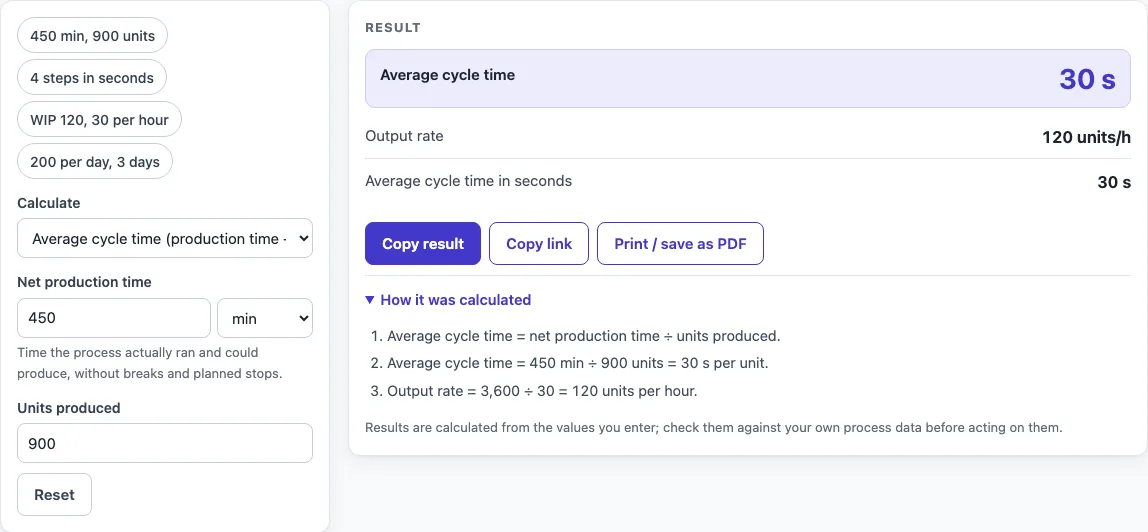
How to use the Cycle Time Calculator
- Under Calculate, choose average cycle time, process steps, or Little’s Law.
- To try a typical case first, click one of the preset buttons above the form, such as “450 min, 900 units” or “4 steps in seconds”.
- In average mode, enter the net production time in seconds, minutes, hours or days. Leave out breaks and planned stops. Then enter the number of units produced.
- In steps mode, enter one step per line, with the step name followed by its time, or only a number. Times can be in seconds, minutes or hours.
- In Little’s Law mode, enter two of the three values (WIP, throughput, cycle time) and choose the unit for each. The tool solves for the third.
- Read the result. Open “How it was calculated” under it to see the formula, the substituted values and the answer with units.
- Check any warning message and correct the input if it applies.
- To start again, click “Reset”.
“Copy link” keeps every input in the page address, and “Print / save as PDF” gives a dated record.
For example, the “4 steps in seconds” preset lists 12, 18, 9 and 15 s and shows an 18 s bottleneck step and 200 units per hour.
How do you calculate cycle time (the cycle time formula)?
The average cycle time formula is cycle time = net production time ÷ units produced. Net production time leaves out breaks and planned stops, so the figure reflects the time each unit really takes. Use the same time unit for the whole period, or let the calculator convert it; the answer is shown in seconds, minutes, hours or days, whichever reads most easily.
For example, 450 minutes of net production time and 900 units give 450 × 60 ÷ 900 = 30 seconds per unit. The output rate is then 3,600 ÷ 30 = 120 units per hour. If you need to calculate cycle time for a shift, a week or a single order, the formula is the same: only the period changes.
How do you compute or determine cycle time for a line of process steps?
Add the step times to get the total cycle time of one unit through the line, then find the bottleneck, the longest step. The bottleneck sets the pace of the whole line, so the line output rate = 3,600 ÷ bottleneck time in seconds. For steps of 12 s, 18 s, 9 s and 15 s, the total is 54 s, the bottleneck is 18 s and the line can make 200 units per hour. Shortening any other step does not raise output until the bottleneck itself gets faster. The step table under the result shows each step’s share of the total and marks the bottleneck.
What is the lead time formula (Little’s Law)?
Little’s Law links three long-run averages of a stable process: cycle (lead) time = WIP ÷ throughput. Rearranged, WIP = throughput × cycle time and throughput = WIP ÷ cycle time. For example, 120 units of work in process at 30 units per hour gives a lead time of 4 hours, and a throughput of 200 per day with a 3-day cycle time means about 600 units are in process. Use it when you can count WIP more easily than you can time individual units.
Worked examples
| Input | Result |
|---|---|
| net production time 450 min, 900 units | average cycle time 30 s per unit (120 units per hour) |
| net production time 7.5 h, 1350 units | average cycle time 20 s per unit (180 units per hour) |
| 4 process steps, times in s | total cycle time 54 s; bottleneck Weld; 200 units per hour |
| 4 process steps, times in min | total cycle time 28 min; bottleneck Assembly; 5.455 units per hour |
| WIP and throughput given | cycle time 4 h |
| throughput and cycle time given | WIP 600 units |
Calculated by the tool above with these values.
Frequently asked questions
Can I use the results in commercial projects or client reports?
Yes. You can use results in commercial work, including reports, audits, client projects and training material. You do not need to credit the tool.
Is the calculator free, and is anything I type uploaded?
The calculator is free and needs no account. All calculations run in your browser, and nothing you type is uploaded.
Can I print or share a calculation?
Yes. “Print / save as PDF” creates a one-page record with your inputs, results, calculation steps and the date. “Copy link” copies the page address, which stores your inputs, so the same calculation reopens later or can be sent to a colleague.
Why does the calculator show a warning?
Warnings flag inputs that may not give a useful answer. In average mode, fewer than one unit produced triggers a warning. In steps mode, a single step, or tied longest steps, does. In Little’s Law mode, a WIP value that is not a whole number triggers one.
Are the results exact?
The results are calculated from the values you enter. Check them against your own process data before acting on them.
How do I find or figure out cycle time without timing every unit?
Use Little’s Law: count the units in process (WIP) and divide by the throughput. For example, 120 units of WIP at 30 units per hour means each unit spends about 4 hours in the process.
Where do the formulas come from?
- Heizer & Render, Operations Management: cycle time = production time available ÷ units.
- Little (1961), “A Proof for the Queuing Formula: L = λW”, Operations Research 9(3), and Hopp & Spearman, Factory Physics.
Related tools
- Lead Time Calculator: use it to add the stages from order to delivery, or to measure lead time from past orders.
- Takt Time Calculator: use it to find the pace needed to match customer demand.
- Inventory Turnover Calculator: use it to measure how often stock is sold or used over a period.
- Cpk Formula and Calculator: use it to check whether a process stays within its specification limits.
- EOQ Formula and Calculator: use it to find the order quantity that minimises ordering and holding costs.
- First Pass Yield Calculator: use it to find the share of units that pass without rework.
- Gage R&R Formula and Calculator: use it to check how much of your measurement variation comes from the measuring system.
- Kanban Formula and Calculator: use it to size the number of kanban cards for a flow of parts.
- All manufacturing and inventory calculators: use it to browse every calculator on the site.